Italy
Villa d'Este

Villa d'Este, Tivoli is a masterpiece of Italian Renaissance architecture and especially garden design.
The ensemble of the palace and gardens was laid out in the second half of the 16th century on the orders of Governor Cardinal d'Este. Its terraced water garden decorated with architectural elements such as monumental fountains had a profound influence on European landscape design.
Community Perspective: The garden provides a nice 1.5-hour stroll up and down the terraced hill, with the fountains as highlights (if they're running). The palace/villa isn’t particularly interesting. Overall it feels like an old-fashioned tourist attraction that could use some TLC.
Site Info
Official Information
- Full Name
- Villa d'Este, Tivoli (ID: 1025)
- Country
- Italy
- Status
-
Inscribed 2001
Site history
History of Villa d'Este
- 2001: Inscribed
- Inscribed
- 1995: Revision
- Temporarily combined into a single TWHS with Villa Gregoriana until just before inscription in 2001, after having been listed alone from 1984
- Type
- Cultural
- Criteria
- i
- ii
- iii
- iv
- vi
Links
- UNESCO
- whc.unesco.org
- Official
-
- visittivoli.eu — Villa d'Este, Tivoli (Italy)
All Links
UNESCO.org
- whc.unesco.org — whc.unesco.org/
Official Website
- visittivoli.eu — Villa d'Este, Tivoli (Italy)
News Article
- May 8, 2025 galeriemagazine.com — In Tivoli, a Roman-Era Grotto Is Revived After a Lengthy Restoration
Community Information
- Community Category
- Secular structure: Park or garden
- Secular structure: Residence
Travel Information

Recent Connections
-
Spolia
Loggia of Hercules: "The decoration of …
-
Self-portraits
According to tradition, the painting of…
-
Popes
The Fountain of the Dragons was "erecte…
Connections of Villa d'Este
- Individual People
-
-
Painted by JMW Turner
Villa d'Este (circa 1796) (Wikimedia)
-

- Trivia
-
-
WHS inspiring "Classical Music"
"Les jeux d'eaux à la Villa d'Este" by Franz Liszt. Also in the same suite "Aux cyprès de la Villa d'Este I & 2"See www.youtube.com
-
In the Louvre
Loggia of Hercules: "The two statues were sold in the 18th century, and are now at the Louvre (Hercules and Telephus) (...)." (Nomination file, p. 59) (Link)
-
Built or owned by French
The construction of the Fountain of the Organ was started by the French fountain builder Luc Leclerc. His nephew Claude Venard continued the construction after Leclerc's death in 1568. Venard also invented the water-operated organ. (Nomination file, p. 48)
-
Dragon
Fountain of Dragons
-
- History
-
-
Habsburgs (Austrian)
"In 1796, the House of Habsburg took possession of the villa, after Ercole III d'Este bequeathed it to his daughter Maria Beatrice, married to Grand Duke Ferdinand of Habsburg." - The last private owner of the villa was Archduke Franz Ferdinand of Habsburg-Este, heir to the throne of the Austro-Hungarian Empire; he wanted to get rid of it, selling it to the Italian State for the enormous sum of two million lire of the time, for which the Italian government procrastinated for a long time. (Wikipedia)
-
Popes
The Fountain of the Dragons was "erected for a visit in 1572 of Pope Gregory XIII whose coat-of-arms features a dragon." (Wikipedia)
-
Contains significant structures from the 20th Century
"Bernini's Cascade was replaced in 1927 by Neptune's Fountain that hides the entry to the Cave by its high and violent spouting. Although it is a modern structure, it is one of the most famous fountains of the garden, especially because of its spectacular waterworks." (Nomination file, p. 61) – "Directly below the Fountain of the Organ, and receiving the water from the upper fountain, is the Fountain of Neptune, a work created in the 20th century to replace a garden landmark which had deteriorated." (Wikipedia)
-
- Architecture
-
-
Baroque
Some Baroque works (including Bernini's) were added and are fully preserved (nom file) -
Spolia
Loggia of Hercules: "The decoration of the outer surfaces was completed in 1632 (...) and to this end ancient marble was taken from Hadrien's Villa." (Nomination file, p. 59) – "D'Este commissioned a prominent classical scholar, Pirro Ligorio, who had studied the Villa Hadriana and other Roman sites in the vicinity, to plan a new villa and garden which would exceed anything the Romans had built. He obtained an abundant supply of marble and statuary from the ruins of Hadrian's villa". (Wikipedia)
-
Mannerism
Terraced garden -
Glazed tiles
In the Grotto of Diana, some "of the original majolica floor tiles from the 16th century can still be seen." – The Fountain of the Dragons "is enclosed by two semi-circular ramps which lead to the level above. The walls of the ramps around it are covered with pebbly tartar and ornamented with bands of mosaic and majolica tile, and contain two large niches." (Wikipedia)
-
Mosaic art
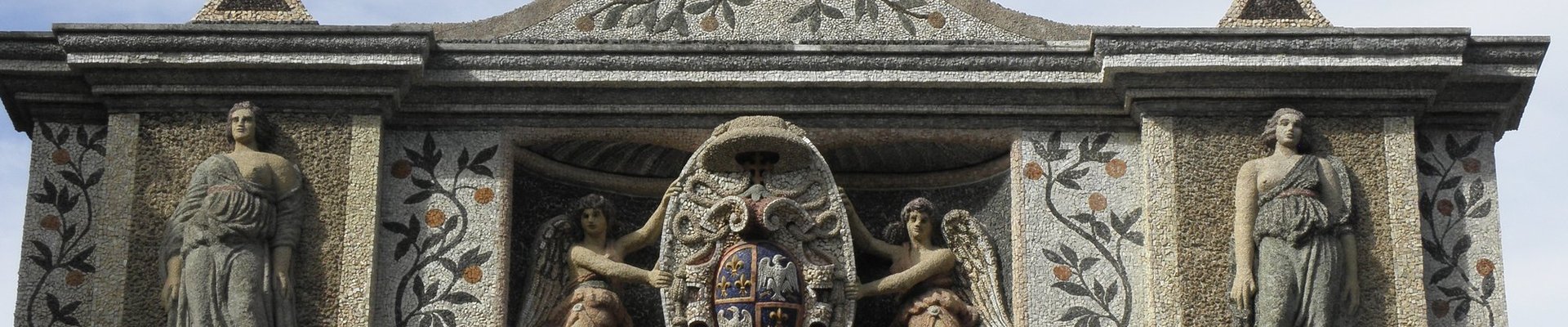
Fountain of the Owl: "The façade (...) is totally covered with a mosaic made of multicoloured marble tesserae. The central large niche is skirted by columns, placed into a concave space, coated in tartaro, as the lateral counterpillars, thus making the mosaic decoration of the columns – wreathed with boughs bearing the Hesperides golden apples – stand out." The Grotto of Diana features "grotesque figures in mosaic". "The walls of the grotto [di Igea ed Esculapio] and of the external cornice are in tartaro and coloured tessera mosaic". (Nomination file, p. 53, 56, 58) – "The Grotto of Diana (...) is a large underground vaulted chamber (...) completely covered with mosaics of mythological scenes, with images of fish, dragons, dolphins, pelicans and other animals, as well as the eagles and apples of the d'Este family." (Wikipedia)
-
Faux marble
The walls of the Private Chapel in the Palace feature "a framework of Ionic pilasters, over a wainscot of false marble". False marble is also used in the decoration of the Halls of the lower floor and the First and Second Tiburtine Halls. False marble is also used on the Fountain of the Organ, the Fountain of Persephone and the Fountain of the Unicorn. (Nomination file, p. 39, 40, 41, 48, 55, 57)
-
Grotesques
Grotesques can be found in the decoration of the Halls of the lower floor, the Hall of Noah, the Hall of the Tivoli Fountain, the Hall of Hercules and the Hall of Nobility. Grotesques can also be found on the Fountain of the Organ, the Fountain of Persephone and in the Grotto of Diana. (Nomination file, p. 40, 41, 42, 43, 48, 55, 56)
-
Designed by Pirro Ligorio
Gardens -
Renaissance
"The Villa d'Este in Tivoli is one of the most remarkable and comprehensive illustrations of Renaissance culture at its most refined." – Criterion (i): "The Villa d'Este is one of the most outstanding examples of Renaissance culture at its apogee." – Criterion (iii): "The principles of Renaissance design and aesthetics are illustrated in an exceptional manner by the gardens of the Villa d'Este." - Criterion (iv): "The gardens of the Villa d'Este are among the earliest and finest of the giardini delle meraviglie and symbolize the flowering of Renaissance culture." - Criterion (vi): "The Villa d'Este, with its palace and gardens, bears exceptional testimony to the Italian Renaissance and has been a source of artistic inspiration ever since its creation." (OUV)
-
Italian Renaissance garden
One of the most significant and best preserved examples of Italian garden (nom file)
-
- Damaged
-
-
Damaged in World War II
Bombed in 1944
-
- World Heritage Process
-
-
2 or more nominated criteria rejected by AB
Rejected: 5, 6. Accepted: 1, 2, 3, 4.
-
Perfect Inscriptions
2001 -
Reduced from broader TWHS
TWHS originally included Villa Gregoriana as well. -
Cultural landscape not recognized
"It is also a cultural landscape" (AB) and Fowler "Villa d'Este, Tivoli, Italy, inscribed but not recognized as the category 1 cultural landscape which it clearly is;" Page 23
-
- Religion and Belief
-
-
Franciscan Order
Cardinal Ippolito d'Este became Governor of Tivoli, which "came with an official residence located in a former convent of the Benedictine order, which had been built in the 9th century on the site of an old Roman villa. In 1256 it had been donated to the Franciscan order." (Wikipedia)
-
Hercules
Hercules was the legendary ancestor of the Este family - statue of Hercules stands in the garden (AB ev) -
Benedictines
The palace is built on an old Benedictine monastery, "whose structure was partly used". (Nomination file, p. 36-37) – "The Courtyard of the Villa was originally the cloister of the convent" (Wikipedia)
-
- Human Activity
-
-
Frescoes or murals by famous painters
The palace has "pictorial cycles painted by famous artists from the Roman Mannerist school, such as Federico Zuccari and Girolamo Muziano" – "The pictorial decoration of the Cardinal's private apartment on the Piano Nobile (...) was painted around 1568 by Livio Agresti and his assistants". (Nomination file, p. 8, 38-39)
-
Grand Tour
"For centuries the Villa d'Este was a must in travellers' and artists' Grand Tours in Italy." (AB Ev)
-
Irrigation and drainage
"The gardens with the fountains, is a masterpiece of hydraulic engineering, both for the general layout of the plan and the complex system of distribution of water as well as for the many water plays with the introduction of the first hydraulic automatons ever built." (OUV) – "The Villa's water supply system is inspired by Roman technology (...). Terracotta pipes, siphons originally used in the Villa, the whole gravity system were no doubt taken from Roman hydraulic engineering technology (...)." (Nomination file, p. 17)
-
Locations for playing sport
From the Hall of the Hunt, a "stairway of travertine stone, called the "snail stairway", descends to the garden. It was originally built to access a pallacorda court, an ancestor of tennis, which Ippolito imported into Italy from the French Court. The space where the court was located now houses the cafeteria and bookstore." (Wikipedia)
-
Boats
At the Rometta Fountain: in a small pool floats a boat with a mast in the shape of an obelisk, illustrating the Tiber island (AB ev) -
Self-portraits
According to tradition, the painting of Mercury in the Hall of the Fountain of the palace is a self-portrait of Girolamo Muziano. (Wikipedia)
-
Grand Cascade
"Here are to be found (...) the first "water staircases" (Scala dei Bollori, and long narrow basins, called water chains)" (AB Ev) – "The Villa d'Este water staircases are the first in a series of similar and ever more extraordinary inventions (...)" (Nomination file, p. 21)
-
Man-made Terraces
"Between 1563 and 1565 the land was remodelled to create a steep slope descending to the old monastery and another gentler slope facing the north-east. A terrace was laid out in the south-west, supported by the old wall of the town." (AB Ev) – "The Villa d'Este (...) is a masterpiece of Italian architecture and garden design, famous for its terraced hillside Italian Renaissance garden and the ingenuity of its architectural features". – "Between 1563 and 1565, a huge amount of earth was excavated and used to construct new terraces". (Wikipedia)
-
- Constructions
-
-
Sphinx
Mannerist sphinx -
Obelisk
At the Rometta Fountain: in a small pool floats a boat with a mast in the shape of an obelisk, illustrating the Tiber island (AB ev) -
Monumental Fountains
Trevi, Fountain of the Four Rivers, Triton Fountain -
Water Organ
The most famous water organ of the 16th century was at the Villa d'Este in Tivoli. ..., it stood about six metres high under an arch, and was fed by a magnificent waterfall. ... There are still traces of the instrument at the Villa d'Este but the mineral-rich water of the river which cascades through the organ grotto has caused accretions which have hidden most of the evidence from view. (wiki) -
Loggia
Gran Loggia -
Cryptoporticus
The Manica Lunga cryptoporticus (Nomination file, p. 38)
-
- WHS on Other Lists
-
-
European Route of Historic Gardens
Villa d'Este (Link)
-
- Timeline
-
-
Built in the 16th century
unique example of an Italian 16th-century garden (AB ev)
-
- WHS Hotspots
- WHS Names
-
-
Named after individual people
The Villa was named after and commissioned by Cardinal Ippolito II d'Este (1509–1572) (wiki)
-
- Literature & Film
-
-
Location for a classic movie
Three Coins in the Fountain, a 1954 American romantic comedy film (won 2 Oscars in 1955)See www.imdb.com
-
Poetic Quotations
Gabriele d'Annunzio wrote a poem entitled "Villa d'Este" in his "Elegie romane" (Roman Elegies): "Parlan, fra le non tocche verzure, le cento fontane: / parlan soavi e piane, come feminee bocche," (The hundred fountains speak among the untouched greenery: / they speak softly and smoothly, like feminine mouths) ( (Nomination file, p. 9) (Link)
-
News
- galeriemagazine.com 05/08/2025
- In Tivoli, a Roman-Era Grotto Is R…
Recent Visitors
Visitors of Villa d'Este
- AC
- Adam Hancock
- Adrian Turtschi
- Afshin Iranpour
- Albert
- Alberto Rodriguez Gutierrez
- Alexander Barabanov
- Alexander Lehmann
- Alex Goh
- A. Mehmet Haksever
- Ammon Watkins
- Argo
- Aspasia
- Assif
- Astraftis
- Atila Ege
- Axel Hansson
- BaziFettehenne
- Bernard Joseph Esposo Guerrero
- Bill Maurmann
- Bin
- butterflybird
- c82wc1
- Carlos Sotelo
- Cezar Grozavu
- Chalamphol Therakul
- chenqtao
- Cheryl
- Christer Sundberg
- Christian Wagner
- christof
- Christoph
- Christravelblog
- Claire Bradshaw
- Clyde
- Colossus
- Coppi
- Csaba Nováczky
- ctravel
- Cyberczar
- CynthiaW
- Dagmara
- Damientournay
- Daniela Hohmann
- Daniel Chazad
- Daniel Gabi
- Dan Pettigrew
- David Aaronson
- David Berlanda
- David Marton
- Deffra
- Dimitar Krastev
- Dimitrios Polychronopoulos
- DonQuijote
- Dorejd
- Doubanjiang
- DouglasR
- Dr. Caligari
- Elaine McArdle
- Elena Y
- Elia Vettorato
- eljx1988
- Ellen Nielsen
- Els Slots
- Emilia
- erdsaumnaht
- Erfe91
- Errol Neo
- Eva Kisgyorgy
- Evgenii
- Fan Yibo
- Farinelli
- Feldhase
- Femke Roos
- finsbury_jo
- Flexiear
- Frédéric M
- Frederik Dawson
- Galgalula
- Gary Arndt
- Geert Luiken
- Geo.Mav
- George Gdanski
- GeorgeIng61
- GerhardM
- Hadrianus
- Harry Mitsidis
- Hasco
- hdimoshi
- Henri
- Hubert
- Hughes1920
- Iain Jackson
- Ian Cade
- Ilya Burlak
- IreneKD
- Ivan Rucek
- Jaakkotoivanen
- Jakob F.
- James Bowyer
- Janina Lehmann
- Jarek Pokrzywnicki
- Jasam
- Jawnbeary
- Jay T
- Jean Lecaillon
- Jeanne OGrady
- Jeffrey Chai
- Jens
- Jezza
- JJ10
- JL
- João Aender
- Joel on the Road
- Jonas Hagung
- Jonas Kremer
- Jonas Martinsson
- Jon Eshuijs
- Joyce van Soest
- Jurre
- Justin
- Kasper
- KateY
- KeithBailey
- Ken DJ
- Klara Woodson
- Klaus Freisinger
- Krzysztof B
- La Concy
- Lara Adler
- Laurine
- LaVale
- Liamps91
- lichia
- Lisu Marian
- Loic Pedras
- Luboang
- Lucio
- Ludvan
- Luis Filipe Gaspar
- Maciej Gil
- Maciej Gowin
- Mahuhe
- Malgorzata Kopczynska
- marcel staron
- Marlies van Wolfswinkel
- Martin
- Martina Rúčková
- Mateusz
- MAURO PODDA PANI
- MaxHeAnouBen
- MaYumin
- MH
- Michael Ayers
- MichaelH
- Michael Novins
- Michael Turtle
- Mikko
- Mikko Syrjä
- Ming_9734
- miri2808
- MMM
- Monica Tasciotti
- Morodhi
- MWaters66
- nan
- Nasebaer
- Nick M
- Nicole Lampos
- Nihal Ege
- NoahFranc
- Olli-Pekka Turunen
- opperpco3
- PabloNorte
- Palimpsesto
- Patrik
- Paul Schofield
- Peltzi
- PeterH
- Peter Lööv
- Petteri
- Philipp Leu
- Philipp Peterer
- Pieter Dijkshoorn
- Pink Bunny
- Piotr Wasil
- Potsdamer
- pressdm
- Priyaranjan Mohapatra
- Purrfect
- Rafał Kałczuga
- Ralf Regele
- Ralf Rotheimer
- Randi Thomsen
- Reiseblitz
- Reisedachs
- Reza
- Riccardo Quaranta
- rivr
- RJPTravel
- Roccobot
- Roel Sterken
- Roger Ourset
- Roman Bruehwiler
- Roman Raab
- Ronbon
- Rubbie
- Sabrina Liebehentschel
- Samy G
- sandersx2
- Sandra!
- Schnitzel
- Sebasfhb
- serghei.belous
- Sergio Arjona
- Shandos Cleaver
- Simonh
- SirLoydd
- Solivagant
- Squiffy
- Squire Sullen
- Stanislaw Warwas
- StaziG
- Stefan A. Michelfeit
- Svein Elias
- Szucs Tamas
- Tamara Ratz
- Tammy Gouldstone
- Taotao Chen
- Tarquinio_Superbo
- Tcchang0825
- Thomas Buechler
- Thomas van der Walt
- Tim Allen
- Tom Flaten
- tommasorossotti
- tony0001
- triath
- Tsunami
- Twobaconsandaboston
- Valentina
- Vanessa Buechler
- Van Hung
- Viaje al Patrimonio
- Vincent Cheung
- VLabhard
- V&M
- Walter
- Waters88
- WILLIAM RICH
- Wojciech Fedoruk
- Xander Huang
- Xiong Wei
- Xiquinho Silva
- Yevhen Ivanovych
- Zoë Sheng
- Zos M
Community Reviews
Show full reviews
Rising up a winding road, you begin to experience the decadence of Tivoli's premier villa before you've even reached it thru a magnificent view shooting straight to the horizon. It seems to yell, "you, Cardinal d'Este, hold dominion over the trees and the houses of the land through God." It also serves to forget that you, the modern public transport user, have arrived not via a direct link from the city centre but from a bus station on the outskirts of the city!
It's almost underwhelming in comparison when you step through the courtyard and into the actual Villa building. It's beautiful, of course, but it feels strangely sparse, a world populated not by objects but by painted doorways and faux-3D marble busts. Through an exhibition you go, the interesting but tenuously linked "Umano Troppo Umano" on depictions of the athletic (mostly nude) body on the day I went, and past all the usual rooms you'd expect from a mid-millennium wealthy religious European, and you finally reach the garden that has been teasing you since you looked through your first window.
On a hot and humid October day, something I'm ill-accustomed to coming from Ireland, I believe I discovered instantly what paradise feels like - fifty fountains, and ten times the spouts. You're immediately welcomed with a drinking fountain at the foot of the staircase, the first of many, which most people (including myself) felt invited to drink from. Ornary drinking fountains are here everywhere as in Rome, …
Keep reading 0 comments
In June 2018, after visiting Villa Adriana and Villa Gregoriana and enjoying pasta on a terrace in the centre of Tivoli, I now had to explore the gardens of Villa D'Este to complete the hat trick. So I walked from the centre of the small town to the Renaissance palace. The frescoed walls and ceilings in the palace are pretty, but don't stand out from the crowd, especially in Italy. It is nevertheless pleasant to walk through the rooms of the building. However, the highlight is the garden. Large trees and well-trimmed hedges overhang and surround hundreds of fountains.
Although the Fontana dell'Organo was not in operation at the time of my visit, I enjoyed admiring the other works of art. After all, that's what these fountains are! The Fontana Di Tivoli (or dell'Ovato), the Fontana di Nettuno and the Viale delle Cento Fontane are the most beautiful in my opinion. They are original, make clever use of water and are full of sculptures and small details. The others, in the four corners of the garden, are not to be overlooked, however, and are well worth a look. The use of vegetation enhances many of these, although the plants could do with more flowers. The Fontana della Rometta, in the southern corner of the garden, also has an interesting layout. The many paths that criss-cross the site offer several fine views, not only of the garden but also of the valley below. On another note, as noted by Els six …
Keep reading 0 comments
There is no doubt that Villa d'Este is a beautiful site, a fine house with gardens sloping down a hillside overlooking the Italian countryside. The town of Tivoli itself, surrounding the villa, is rather spectacularly set in the Sabine Hills east of Rome, overlooking the falls of the Aniene River. It is quite easy to see why this area was favored as a retreat by church and state in Rome -- it feels a world away from the eternal city.I visited Villa d'Este in November last year. Perhaps autumn is an off season, but I had to adjust my hopes for this site when I arrived at the ticket office and learned that none of the fountains would be running, as they were under repair. For me, this was a bit like my first visit to Versailles, a weekday with no grand fountains on display. Except that the villa is in no way comparable to the richly ornate Palace of Versailles. The fountains are the main draw to the Villa d'Este, and without them, I was left wanting more.
That said, the gardens on a fall day were beautiful to walk through, and I could imagine what the fountains would look like were they operating in their cascades and grottoes. The gardens also weren't terribly crowded in November (perhaps because visitors knew in advance the fountains were not working?), so I never felt crowded wandering the grounds. Still, just like the Palace of Versailles, I know I'll have to …
Keep reading 0 comments
Tivoli is a relatively short train ride from Rome and has been a popular destination for excursions and a countryside residence for Romans since ancient times. While the Villa Adriana is a few kilometres outside the centre, Villa d'Este is right in the centre. Commissioned by a Renaissance cardinal, it is considered to be the defining masterpiece of Italian landscape architecture and garden design. The garden is indeed very pleasant for a stroll, full of fountains, ponds and other water features, although I visited a bit too early (in early March) to enjoy the full spring bloom. The villa itself, though, was not particularly impressive, and can be skipped if you are short on time. Besides the 2 villas inscribed on the WH list, Tivoli features a third one that is in my opinion the equal of the other 2 - the Villa Gregoriana, famous for its unique combination of a natural landscape and one altered by men since antiquity. I certainly enjoyed my walk down to the valley floor and up again on the other side, always admiring viewpoints, caves, waterfalls, and a number of manmade structures. It has been on Italy's tentative list for a long time, but I doubt that UNESCO would inscribe a third separate site in such a small town - an extension of Villa d'Este would be justified, though.
Keep reading 0 comments
I visited this WHS in March 2014. I went there early to beat the crowds and I enjoyed the Fontana deli Organi at 10.30am. The villa interior reminded me of Ferrara's Castello Estense. The highlights of the Renaissance gardens are the Rometta, Neptune's Fountain and the Cento Fontane. Although I enjoyed my visit, the Villa gardens weren't very well kept for a WHS especially when it costs 8 euros to visit!
Keep reading 0 comments
The Villa d'Este lies in the center of Tivoli. Due to its proximity to Rome I guess, it attracts more than half a million visitors a year. It's a bit of an old-fashioned tourist attraction, the main point of interest is its garden with water features. I stayed in a B&B within walking distance, and so was able to get in before 9 a.m. This way I had the whole garden to myself, except for a cat that sought my companionship.
I roamed around for about 1.5 hours. The differences in height make for good exercise, and the site has enough on offer to pleasantly surprise now and then. The most impressive parts I found were the Organ Fountain and the one representing Rome. I did a quick tour through the villa as well. Every room is covered in wall paintings.
After a while, I became aware that parts of the site actually are quite run-down, or need more care than they're getting now. About a third of the fountains were not working (especially the smaller ones). I don't know if this is a case of "the tourists will come anyway, so why bother", or that a severe lack of funds is hindering the upkeep of the site. Surely there could be made more out of it than is now.
Keep reading 0 comments
This villa clearly receives the larger share of visitors to Tivoli. The gardens seem to be the main attraction of course with their flowing waterfalls and fountains. Few visitors seemed to venture inside the villa though, but I found it worthwhile to see the palatial frescoed home of Cardinal d'Este.
I reached Piazza Garibaldi in Tivoli by bus from outside Ponte Mammolo metro station.
Keep reading 0 comments
We finally got there after many, many past trips to Rome and surroundings. We should have gone sooner!! Breathtaking and really an architectural marvel. It just goes to prove that tourists need to get away from the cities and discover sites on "the roads less travelled" like this one. I now recommend a tour of the Castelli Romani and Villa D'Este/Tivoli, in particular, to all my friends who are heading to Rome. It is well worth the effort to get there.
Keep reading 0 comments
One of the more breathtaking experiences of my life. The combination of tranquility and chaos that the water features bring about is something everyone should be so lucky to experience.
Villa d'Este will always have a special spot in my memories!
Keep reading 0 comments