One day is not enough to visit the grounds and palaces of Versailles, especially for those who would like to visit the interiors. We did it once with the children and a second time without them. The second time, we parked Wilson 1st the mobilhome at the campsite in Versailles and went to the estate by bike. This is the best way to visit this vast estate; it's peaceful, and you don't have to look for a parking space. The campsite is located 4 km from the palace, and you take the wide Avenue de Paris which leads directly to the gate of the main courtyard.
One small drawback, however: nothing is provided for cyclists and you have to lock your bikes to a lamppost, which is not very reassuring!
In 2021, despite the low number of visitors due to the Covid19 pandemic, and as the weather was uncertain but dry, we decided not to visit the interiors of the palaces, but to explore other places in the park, by bike if possible given its size.
Because it seemed important to us not to miss anything on the entire estate, and cycling is certainly a good way to get from one place to another along the paths. You mustn't miss anything because each location on the estate was, in a way, the model for a new architectural style that was subsequently reinterpreted throughout the Western world.
The Palace of Versailles
The castle as we know it today required four construction campaigns ordered by King Louis XIV between 1664 and 1668, 1669 and 1672, 1678 and 1684, 1699 and 1710 on the basis of a pre-existing U-shaped castle around the courtyard known as the "Marble Court" built during the reign of King Louis XIII, between 1631 and 1639. At that time, the castle and its outbuildings were designed mainly by the architects Louis Le Vau: buildings with their facades on the garden, Charles Le Brun: interior fittings and decorations and André Le Nôtre for the gardens. This team had already worked together on the construction of the Château de Vaux-le-Vicomte for the King's Superintendent, Nicolas Fouquet, who was on France's tentative list. Château de Vaux-le-Vicomte After Louis Le Vau's death, other architects took over the construction of the palace, including the equally renowned Jules Hardouin-Mansart, who was also responsible for the construction of the royal stables on the Place d'Armes and the royal chapel (see photo).
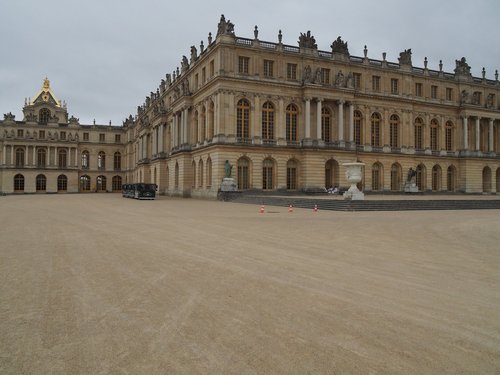
In 1682, Louis XIV was finally able to establish the court and government of France in what would become one of the largest and most prestigious palaces in Europe.
The gardens and grounds of Versailles
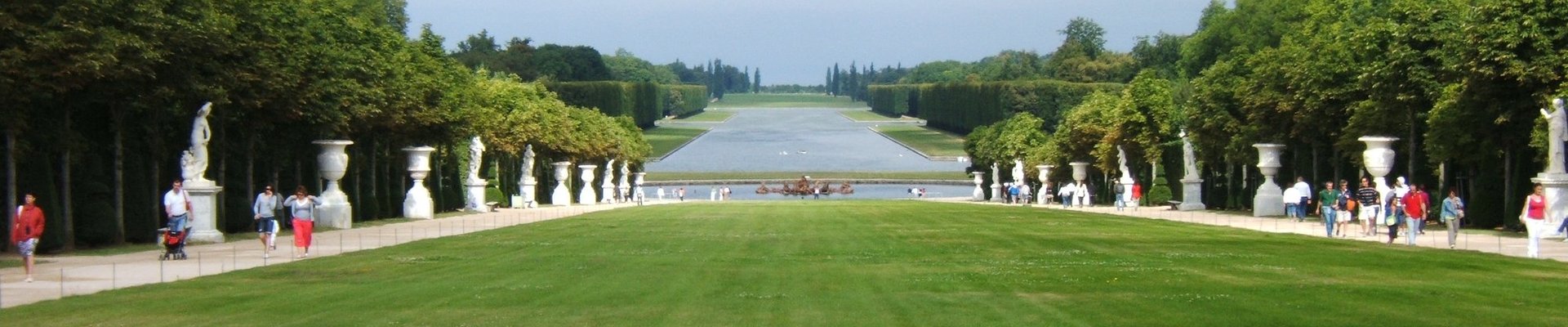
Of the original 8,000 ha estate, only 815 ha remain today, but it would be a shame not to stroll around and enjoy the surprises created by André Le Nôtre and a host of sculptors. There are several possible entrances to the park, which is very convenient when you are on a bicycle because it is not permitted to access the gardens themselves from the Royal Court where the entrance tickets are purchased. We entered through the "Sailors' Gate" to the west, and the Saint Antoine Gate to the east. The advantage of entering through these gates? Access is free for pedestrians and cyclists, and you can directly access the other areas of Versailles by bike: the Grand and Petit Trianon, and then on foot, Marie Antoinette's estate. At the rear of the château, the view of the Apollo Basin and the Grand Canal from the terrace is spectacular (see the introductory photo). Don't hesitate to stroll around the formal French gardens and groves. Each pond and grove is a marvel in itself. We decided to wander around, more or less following the routes suggested by the Guide vert. Don't hesitate to go down and admire the beautiful views from the Orangery, at the rear left of the palace (see photo).
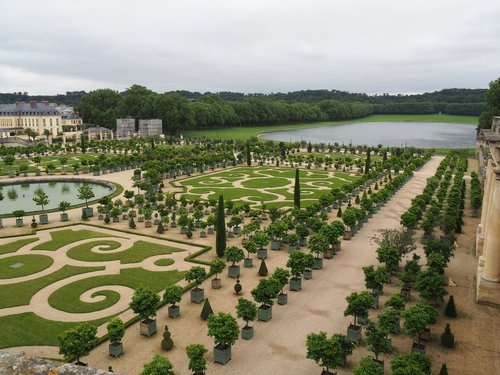
Needless to say, triumphant classicism found many defenders around the world and André Le Nôtre's garden design greatly inspired many landscape architects thereafter.
The Grand Trianon and the Petit Trianon
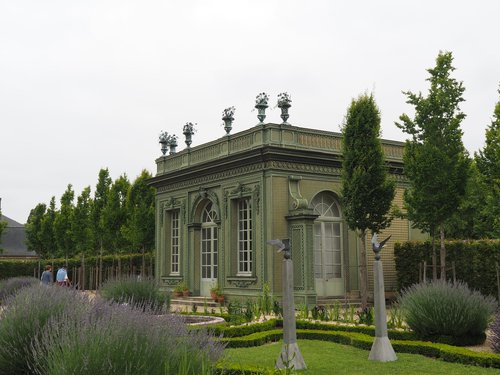
It is possible to pay for your entrance ticket to the Trianon estate which includes entry to the Grand Trianon, the Petit Trianon and Marie Antoinette's estate. You have to leave your bike at the entrance and continue on foot. It's the most pleasant part of the park. There are fewer people, and the style and scale of the buildings are less overwhelming. There, one discovers little marvels such as the "Salon frais," a kind of open-air dining room where King Louis XV used to have lunch. This little gem, entirely covered with painted wooden hurdles (see photo), was designed by another renowned French architect, Ange-Jacques Gabriel, between 1751 and 1753. There is a similar one in the Royal Park of Brussels. Ange-Jacques Gabriel is also the designer of the Château de Compiègne north of Paris, which we also visited and which I recommend (There is a church there which is a UNESCO World Heritage Site. It is part of the Routes of Santiago de Compostela but is not spectacular... and there are necropolises listed as World War I funerary monuments which I did not see). From the gardens of the Grand Trianon, there are also beautiful views of the Petit Canal, which intersects the Grand Canal at a right angle. You feel like you're somewhere else entirely.
Marie Antoinette's Estate
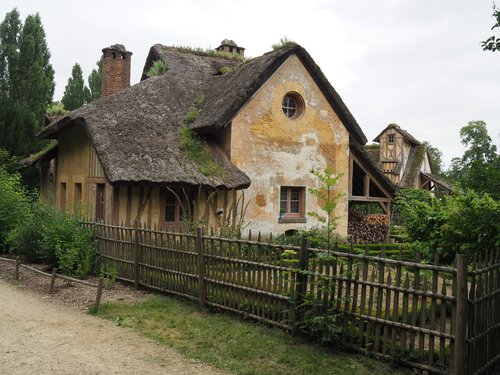
It's accessible on foot. A different era, a different political context, a different place, a different atmosphere. Here, the formal French gardens give way to an English-style garden with its artificial grottoes and classical temples. This spot was the most charming in the park for us, firstly for its historical significance at the pivotal moment of the French Revolution, and secondly for its unique character, as it foreshadows the Romantic style in architecture. Marie Antoinette, an archduchess of Austrian origin, was married to King Louis XVI. She was reportedly inspired by the writings of Jean-Jacques Rousseau, who advocated a return to nature. Following this inspiration, she commissioned the architect Richard Micque to build this faux rural hamlet between 1783 and 1786 in a secluded spot within the park. Everything that made up a "real" country village, which at the time was generally very poor, was reproduced there: vegetable gardens, cows in their meadow, a pond, a mill, a barn, a dairy, cottages with thatched roofs, except that... inside, luxury reigned supreme! Quite curious, isn't it? (The photo).
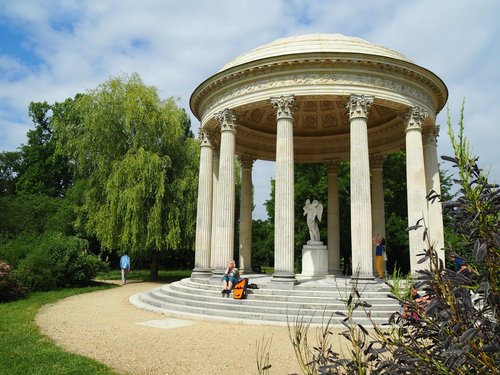
A short stroll through the English garden will quickly make you forget the paradox surrounding the hamlet, for the grottoes and pleasure spots are utterly charming. The Temple of Love is particularly delightful and of ideal proportions. (See photo).
In conclusion, it's entirely possible to spend a whole day exploring the grounds without entering any of the castles, which is a great option for rainy days. The smaller monuments, such as the Queen's Theatre, are open to the public and are magnificent. The global impact of the constructions in the royal domain of Versailles explains... royally, if I may say so, the site's classification as a UNESCO World Heritage Site!
Comments
No comments yet.